Designing With AI, Machine Learning and Data Visualisation I 2022-
The aim of the project is to develop an experimental approach and collaborate on the definition of a new educational module suitable to be applied in multidisciplinary environments that integrate Artificial Intelligence (AI), Machine Learning (ML) and Data Visualization (DV) in Design curricula. This website will provide an online toolkit containing AI/ML/DV tools, resources and methodologies accessible by an audience of design teachers and students with a training background in different design areas.
To facilitate learning and exploration of how Artificial intelligence, Machine Learning and Data Visualization could be integrated into design practices, this database organizes and visualizes AI/ML/DV tools within a novel design system developed by systematizing AI activities within the common stages of design thinking, pursuing the concept of “Learning by searching for”.
–> https://designingwithai.ch/
Institutions involved:
Project Coordination
SUPSI – University of Applied Sciences and Arts of Southern Switzerland
Project Partners
NOVA – Universidade NOVA de Lisboa
EPFL – École polytechnique fédérale de Lausanne
People:
Massimo Botta – SUPSI, Project Coordinator
Antonella Autuori – SUPSI, Research & Teaching Assistant
Matteo Subet – SUPSI, Research & Teaching Assistant
Ginevra Terenchi – SUPSI, PhD Candidate
Matteo Loglio – SUPSI, Teacher
Leonardo Angelucci – SUPSI, Teacher
Serena Cangiano – SUPSI, Teacher
Kim Frederick Chando – EPFL, PhD Candidate and Teacher
Janna Joceli Omena – NOVA, Researcher and Teacher
Eduardo Leite – NOVA, PhD Candidate and Teacher
Profiling Bolsobots Networks I 2021-
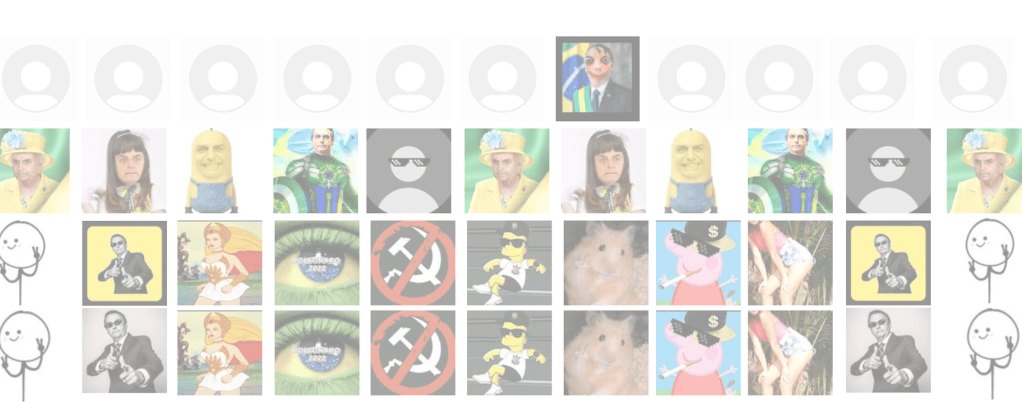
How to capture the operation of political bots networks? Which types of accounts compose bot ecologies? How do bots promote content? To what extent do platform moderation policies impact bots’ activities over time? How does inauthentic activity change as content moderation measures refine their capture of bots and other “platform manipulations”? This project gathers and profiles accounts operating in Brazilian online political debates through the use of quali-quantitative methods. It investigates the activities of pro- and anti- president Jair Bolsonaro bots across platforms (i.e. Instagram, Twitter and TikTok) to make “inauthentic” behaviour visible, as well as addressing challenges of studying networked disinformation environments.
The project explores methodological approaches for studying inauthentic behaviour online that moves beyond bot detection towards an analysis of their vernacular, collective strategies and particularities. The project aims to produce a series of research reports on “bolsobots”, their networks and digital methods recipes to understand their social lives.
Organizations
- Centre for Interdisciplinary Methodologies (CIM)
- iNOVA Media Lab
- King’s College London
- OI Lab
- Universidade do Estado da Bahia
- Universidade Federal do Rio de Janeiro
Collaborators
- Janna Joceli Omena
- Thais Lobo
- Emillie de Keulenaar
- Giulia Tucci
- Francisco Kerche
- Elias Bitencourt
Reports
- Profiling Bolsobots Networks. A quali-quanti approach to repurpose Instagram grammars. Digital Methods Initiative.
- After all, what are bolsobots like these days? #SMARTDataSprint.
- Insta Bots and the black market of social media engagement, Janna Joceli Omena.
- Disinformation and inauthencity in ONU Brasil’s social media spheres, Emillie de Keulenaar.
- Reading Digital Networks: Climate Emergency, Bolsonaro & Bot Image Circulation by Vision API, Janna Joceli Omena.
Articles
- Robôs e desinformação nas redes: O que já se sabe nas eleições 2018. Nexo Jornal.
- When Machine Behavior Targets Future Voters: The Use of Social Bots to Test Narratives for Political Campaigns in Brazil. International Journal of Communication, 15(0), 1220–1223.
MyGender Project I 2021-2024
MyGender project investigates how young adults engage with the technicity and imaginaries of mobile applications, incorporating them into their daily lives, embodying them in their everyday practices and (re)negotiating from it their gender and sexual identities. The project will offer quantitative and qualitative insights into how Portuguese young adults’ engage with different social media and dating to gaming, health and fitness to self-tracking apps.
Team
| Inês Amaral | Principal Investigator (PI) |
| Rita Basílio | Co-PI |
| Ana Marta Moreira Flores | Postdoctoral fellow |
| Eduardo Antunes | MA fellow |
| Sílvio Santos | Researcher |
| Janna Joceli Omena | Researcher |
| Sofia José Santos | Researcher |
| Rita Alcaire | Researcher |
| Filipa Subtil | Researcher |
| Natália Gomes | Junior Researcher |
| Gabriela Poleac | Junior Researcher |
| Frederico Fonseca | Junior Researcher |
Project ˚ ˚ ATMOSPHERES OF DENIAL ˚˚ Public Data Lab
This is a Public Data Lab project that explores digital cultures of climate change denial in collaboration with DeSmog and taking their Global Warming Disinformation Database as a starting point.
Image from “engaged research-led teaching” project undertaken with DeSmog, researchers and students at the Department of Digital Humanities, King’s College London.
Organizations
Collaborators
- Jonathan Gray
- Birgit Schneider
- Tommaso Venturini
- Kari de Pryck
- Janna Joceli Omena
- Thais Lobo
- Liliana Bounegru
Project ˚ ˚ STICK & FLOW: A Critical Framework for investigating bot engagement on social media
[2020-2022]
This project is funded by CAIS – Center for Advanced Internet Studies.
This research group studies the phenomenon of automated engagement on Instagram and Tumblr as an ensemble of software affordances, human interests and techniques of mediation. Using digital methods, media theory and internet ethnography, we argue that the study of social bots should consider three interconnected dimensions:
- the role of web or mobile applications,
- the shifts in societal concerns around bot ‘imagination’ or how users relate to #bots through tagging practices, and finally
- bot agency or what we can learn from detecting and studying visual and textual content provided by social bot accounts.
In order to account for implications and challenges of social automation for the understanding of digital society, we propose a network perspective on the ephemeral dynamics of “stick and flow” that constitute the ways in which bots operate on social media platforms and beyond.
Participants:
- Janna Joceli Omena, Universidade Nova de Lisboa/iNOVA Media Lab, Portugal
- Elena Pilipets, Alpen-Adria Universität Klagenfurt, Austria
- Jason Chao, University of Warwick/Universität Siegen, England/Germany
- Mengying Li, Journalism School, Fudan University, Shanghai
- Ana Marta M. Flores, Universidade Nova de Lisboa/iNOVA Media Lab, Portugal
- Thais Lobo, King’s College London, England
- Giulia Tucci, Federal University of Rio de Janeiro (UFRJ), Brazil
- Francisco W. Kerche, Federal University of Rio de Janeiro (UFRJ), Brazil
- Emillie de Keulenaar, OILab / University of Groningen, The Netherlands
- Elias Bittencourt, Universidade do Estado da Bahia, Brazil
- Sofia Caldeira, Lusofona University, Portugal

 Janna Joceli Omena