This post celebrates five years of the #SMARTDataSprint and, consequently, my experience in designing, conceptualising and coordinating data sprints at Nova University Lisbon; an initiative supported by iNOVA Media Lab, and later also by ICNOVA. Through the practice of digital methods, this event (or annual encounter if you wish) has been directly and indirectly contributing to new forms of design research, ask and respond to research questions.
A journey made of hard work and a list of amazing collaborators but also inspired by the Digital Methods Initiative. Since its second edition, the SMART Data Sprint started to be financially supported by the Doctoral Programme UT Austin I Portugal via iNOVA Media Lab and, particularly, encouraged by the lab coordinator, Paulo Nuno Vicente, and greatly benefit from a collaborator who was present in the last four editions: Bernhard Rieder. Yes, I am super proud to say that this initiative was designed by myself, with many sleepless hours, the fear of not working out (but always moving on one way or another)and the grace of having incredible people believing in such a proposal and making it real. As they say, a dream that is dreamt together comes true. No, I never received a salary to do this, but I had little institutional support 😏🤨 on one hand and very positive feedback from participants and collaborators, on the other 🤓🤩💪🏻👩🏻💻🧑🏽💻👨💻💛. Below a few words that summarise how the idea of the SMART Data Sprint came about.
“The idea of the SMART group first appear in early 2016 in the shape of a one-year research project, and during the Data Laboratory sessions of the Digital Media UT Austin / Portugal doctoral program, at NOVA FCSH – Universidade Nova de Lisboa. The research project was conceptualised by Janna Joceli Omena and entitled “SOCIAL MEDIA PLATFORMS IN PRACTICAL RESEARCH: Designing Data-Driven Techniques with Digital Methods”. Professor António Granado was heading the sessions and mentoring the projects proposals. He came up with the suggestion of using the tool acronym creator because “projects have an acronym”, he said. Relying on the project title, different keywords combination were applied, and among all ordinary, weird, comic or odd options, the chosen one was SMART – short for social media research techniques. “It sounds good!”, that is what they said to each other. After that, and meanwhile the project was taking form, professor Paulo Nuno Vicente (the then newly appointed coordinator of iNOVA Media Lab) invited Janna Joceli Omena for an informal meeting. It did not take too long to put two and two together. On 6 October 2016, SMART was officially presented at iNOVA Media Lab ). Under the leadership of Omena, the group implemented the SMART Data Sprint in January 2017, the first of many to come.”
Source: https://smart.inovamedialab.org/about/everything-started-with/
When watching the video of the official presentation of the group SMART(watch the video here, starting from 22m30s) to write this blog post, I noticed something that hasn´t changed over years, my position about the use of digital methods as a research practice that requires time and practice (as said in the video). Back then, in 2016, I presented one of the main objectives of the SMART group: to conduct exploratory studies on social media using digital methods, considering the layers of technical mediation inherent to these methods. It is stimulating and gives great satisfaction, looking back and seeing how these ideas have developed and grown. This post is a celebration and record of this history which I want to start telling from the last chapter: the 2021 edition of the #SMARTDataSprint. Then, I will walk through all the others, ending this post with how and when everything started. The idea is simply register and celebrate the five years of #SMARTDataSprint. Note that I´m sharing my personal vision, experience and some thoughts, ok? Why I am doing that? Well, first, because I believe in collaborative work (where everyone’s knowledge adds up) and in the potentials of data sprints as valuable tool for digital research. Secondly, the proposal of learning by doing is real and has a lot to add to digital research. Thirdly, there is no way to use digital methods without practising, and the data sprint environment seems to be ideal for this research practice. Finally, I think this post is also an exercise in looking back and evaluating what has been done, and being proud of it but also moving on to what comes next 👩🏻💻😏🤗
The fifth edition: The current state of platformisation, 2021
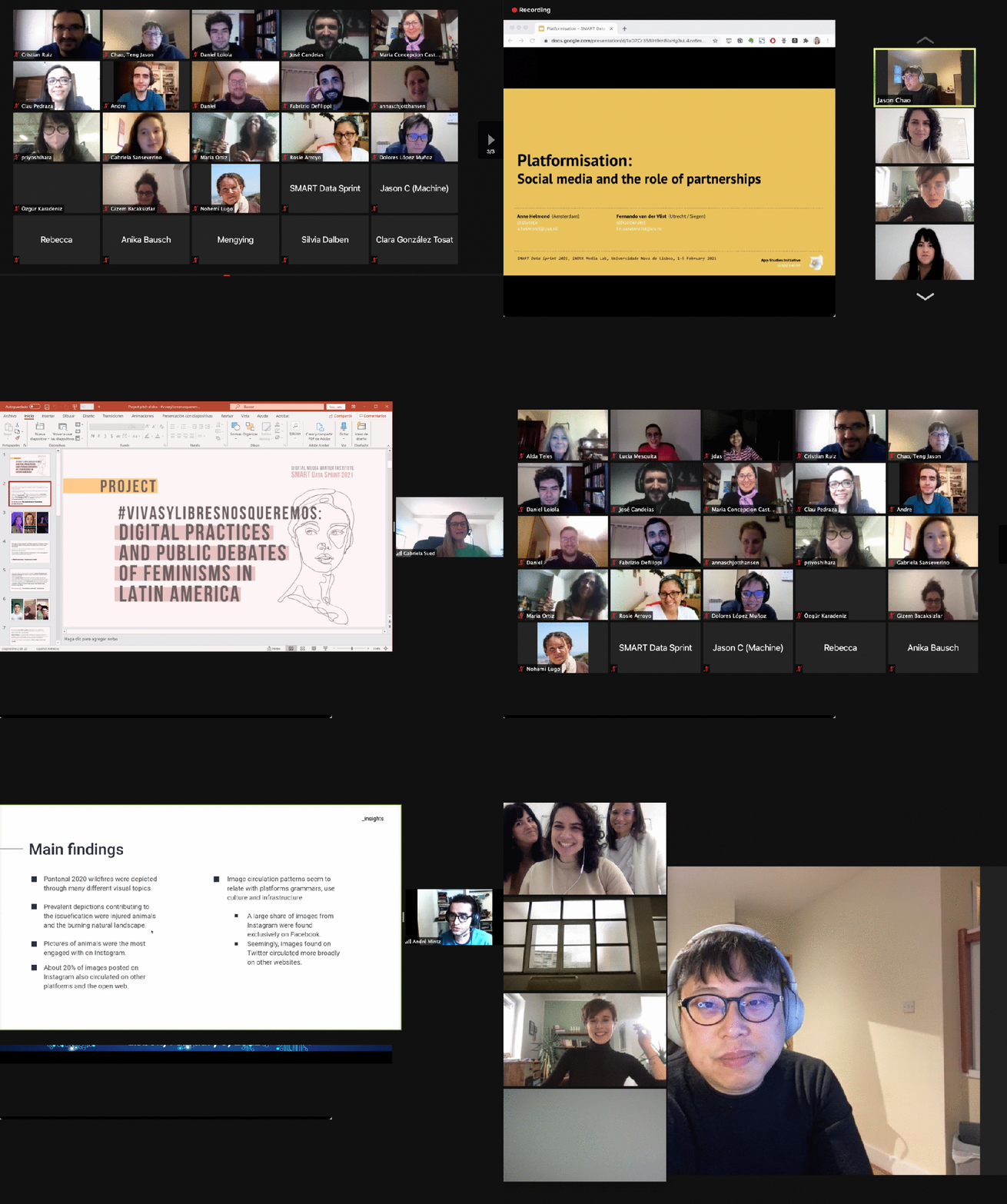
This year the SMART Data Sprint adopted the online mode due to the pandemic, it was a challenge to everyone! The theme was The current state of platformisation which counted with incredible keynote speakers who delivered excellent talks. They are the distinguished professor José van Dijck, the incredibles Anne Helmond and Ariadna Matamoros-Fernández and the amazing Fernando van der Vlist. What a team! Don´t forget to mention a short talk addressed by Elena Pilipets (SMART member) and a long list of collaborators leading practical labs prepared for attending the needs of researchers who were more or less familiarised with the digital methods approach, while other collaborators pitched and led projects. All videos are available here: https://www.youtube.com/watch?v=RjJcf_ihlKo&list=PLcGiWiKtsR0-GWexTZ2_vh9ttPC7zBElu
In 2021, we beat the record of applications, having a total of 70 people from 22 different countries (40 participants and 30 collaborators), and a total of 6 projects. Not mentioning the professors, students, researchers (more than 300) who joined the webinar of the José van Dijck on the A European perspective on platformisation.
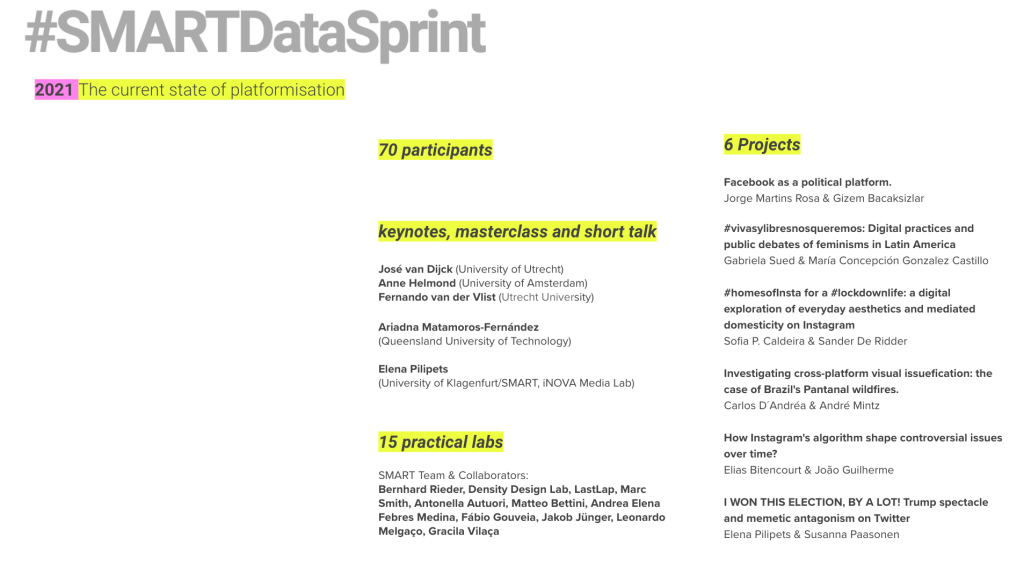
Well, if you read this post until the end, you may understand why the number of people involved matters here. Another good surprise this year was to welcome participants for the second time in a row, which can only point to positive feedback about their experience at the latest data sprint.
Thanks to the involvement of all participants, the dedication of the collaborators and the SMART team – namely Rita Sepúlveda, Ana Marta Flores, Elena Pilipets, Jason Chao and myself, the fifth edition of the SMART Data Sprint was really a success 🙂 I was impressed by the online involvement of everyone during the week, people who challenged the time zones to work in collaboration. This edition was really special indeed, we were so happy to officially welcome the designers’ crew from the Density Design Lab (special thanks to Michele Mauri, Beatrice Gobbo and the work of Andrea Elena Febres Medina, Antonella Autuori and Matteo Bettini) and people like Fábio Gouveia, Jakob Junger, Marc Smith, and the R-Est team represented by Leonardo Melgaço and Gracila Vilaça. Last but not least, A BIG THANKS TO the LastLap for the provision of all the necessary infrastructure to run the data sprint during the lockdown.
Beyond the adrenaline caused by the invitation of the keynotes speakers, followed by the best feeling ever which is when they say yes – that they are happy to join the data sprint, there are two activities that I really enjoy doing; one is to invite project leaders and discuss the potential projects, helping them with the research design of the projects. The other one relates to the period of planning and organising the programme and practical labs, I think I’ll miss that a lot (no, I´m not retiring but I´m definitely taking a sabbatical season as they say). This year, and as usual, there were projects reports with lots of potentials which were facilitated by scholars from different backgrounds and research interests. See below the projects, respective teams and URLs.
#vivasylibresnosqueremos. Feminist Digital Practices and Public Debates in Latin America https://smart.inovamedialab.org/2021-platformisation/project-reports/vivasylibresnosqueremos/
Lead: Gabriela Sued (Estancias Postdoctorales por México Researcher at IIS-UNAM); María Concepción Castillo González
Team members: Sofía Alamo, Rosa E. Arroyo, Antonella Autuori, Andrea Elena Febres Medina, Dorismilda Flores-Márquez, Daniel lssl, Nohemí Lugo, Lucia Mesquita, María Ortiz, Claudia Pedraza, Mon Rodríguez-Amat, Monika Skazedonig, Gracila Vilaça.
Gramming #covid19, reframing the pandemic: Exploring how algorithms and user practices shape COVID-19 imaginaries on Instagram over time https://smart.inovamedialab.org/2021-platformisation/project-reports/gramming-covid19-reframing-the-pandemic/
Lead: Elias Bitencourt, Associate Professor, The State University of Bahia, Brazil; Adjunct Professor, Federal University of Bahia, Brazil; Researcher of LAB404/UFBA, and João Guilherme Bastos dos Santos, Post-doc researcher at the Brazilian National Institute of Science and Technology for Digital Democracy. (INCT.DD); Ahead of INCT.DD’s Data Science for Digital Communication Laboratory (C2D2).
Project Team: Anna Schjøtt Hansen (Research Assistant at Roskilde University, Denmark, part of the DataPublics project), Charis Papaevangelou (PhD candidate at LERASS, Université Toulouse III – Paul Sabatier, France; JOLTETN, H2020/Marie Sklodowska-Curie fellow), Caterina Foa (PhD candidate at Iscte-IUL, Lisbon; Researcher at MediaLab CIES-IUL) and Luís Junqueira (Invited Researcher, SafeConsume Project, Institute of Social Sciences – University of Lisbon).
#homesofInsta for a #lockdownlife: a digital exploration of everyday aesthetics and mediated domesticity on Instagram https://smart.inovamedialab.org/2021-platformisation/project-reports/homesofinsta-for-a-lockdownlife/
Lead: Sofia P. Caldeira & Sander De Ridder
Team Members: Ana Marta M. Flores, Erec Gellautz, Federico Pozzi, Hantian Zhang, Mariah Nikolic, Mengying Li
Investigating cross-platform visual issuefication: the case of Brazil’s Pantanal wildfires https://smart.inovamedialab.org/2021-platformisation/project-reports/investigating-cross-platform/
Project leaders: Carlos d’Andréa and André Mintz – R-EST/UFMG
Team members: Débora Salles, Fabio Gouveia, Federica Laurencio, Jahnnabi Das, Janna Joceli Omena, Leonardo Melgaço and Priscila Yoshihara
I WON THIS ELECTION, BY A LOT! Trump Spectacle and Memetic Antagonism on Twitter https://smart.inovamedialab.org/2021-platformisation/project-reports/i-won-this-election-by-a-lot/
Lead: Elena Pilipets & Susanna Paasonen
Team Members: Alicia Takaoka, Catarina Ferraz, Catherine Baker, Daniel Loiola, Fabrizio Defilippi, Gabriela Gruszynski Sanseverino, Giuliander Carpes, José Candeias, Lola López, Matteo Bettini, Paulina Sierra, Pernilla Severson.
Facebook as a Political Platform: How Portuguese political parties engage with Facebook users https://smart.inovamedialab.org/2021-platformisation/project-reports/facebook-as-a-political-platform/
Lead: Jorge Martins Rosa (Associate Professor, NOVA FCSH; Researcher, ICNOVA), N. Gizem Bacaksızlar Turbic (Post-Doctoral Researcher, ICNOVA), Alda Telles (Doctoral Candidate, NOVA FCSH)
Team members: Clara González Tosat, Cristian Ruiz, Kalliopi Moraiti, Oğuz Özgür Karadeniz (Research Associate, KU Leuven DTAI), Svea Kiesewetter (Doctoral Student, University of Gothenburg), Valentina Pallacci (Master’s student, Politecnico di Milano; Intern, DensityDesign Research Lab)
Now let’s go back to the importance of numbers and why the quantity of people matter. It is not only for fulfilling the financial need or generating funds to make the machine work but also because the #SMARTDataSprint is really something about creating and establishing a community in which we are able to talk the same language, experimenting and trying things out without fear to make mistakes. It is about providing a collaborative environment, reuniting scholars with different expertise and career levels, but willing to contribute and collaborate equally. It is about giving space for students who cannot afford the fee but want to participate. And before you think that these ideas or proposals sound too perfect, I can tell you in advance; no, they are not!! Lots of work, lots of meetings, lots of giving, countless difficulties and hierarchical barriers offered for free by the sweet academic environment. Well, I don’t want to go there, because it is time to celebrate the five years of the #SMARTDataSprint 🥳 🤩 🤓 So, how about moving to edition number 4? From then on, you will find only a summary of the other editions, more thoughts at the end.
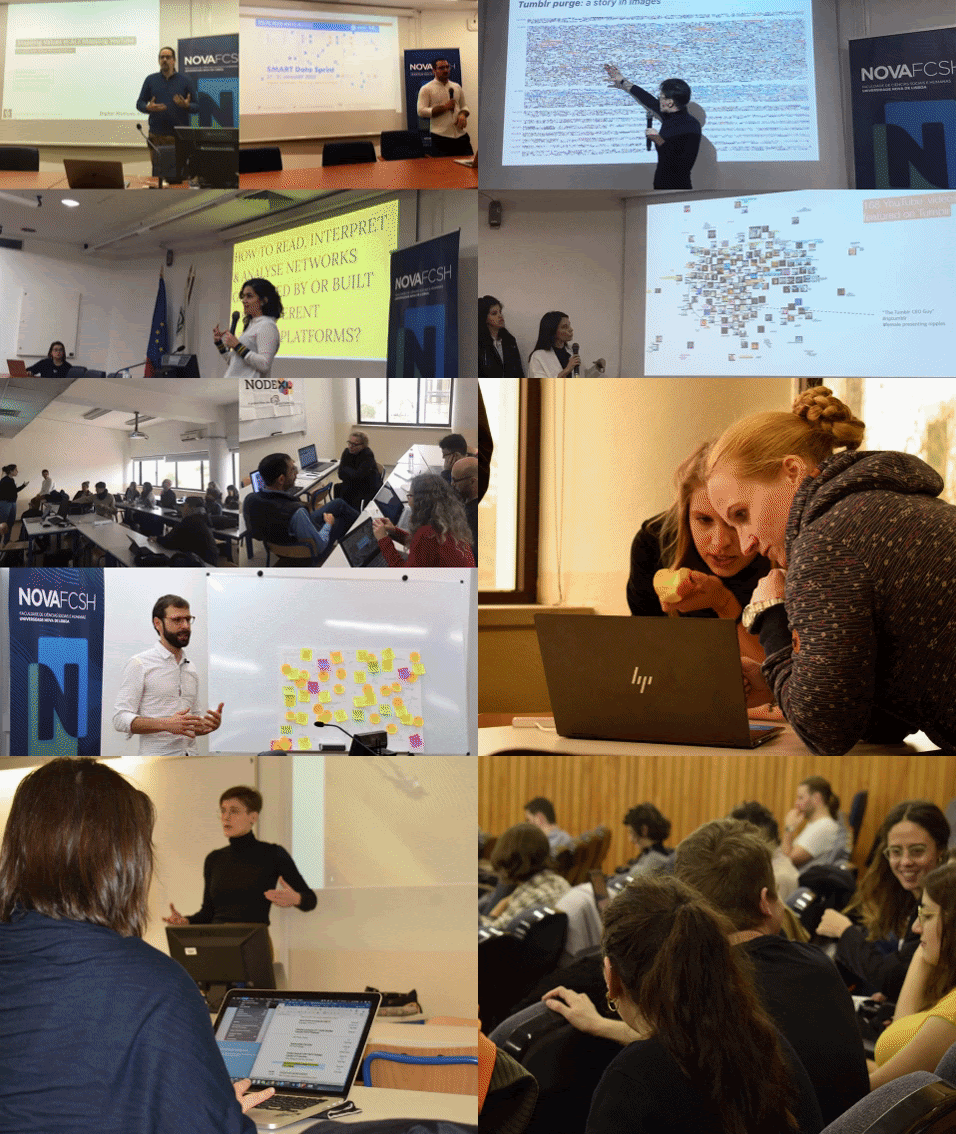
The fourth edition: Digital methods: theory-practice-critique, 2020
Theme: https://smart.inovamedialab.org/2020-digital-methods/theme/
Invited speakers:
Tommaso Venturini with a keynote talk on visual network analysis and practical labs.
Bernhard Rieder addressing a keynote on mapping value(s) in artificial intelligence.
Master class:
Johnnatan Messias talking about countering Misinformation on Social Media Platforms
Short Talk (by myself) about unpacking Digital Methods
Video list: https://www.youtube.com/watch?v=kHPkUGa0unY&list=PLcGiWiKtsR0-GRIY7MBN2i3p3H_DGVz0Q&index=2
Schedule: https://smart.inovamedialab.org/2020-digital-methods/schedule/
Practical labs: https://smart.inovamedialab.org/2020-digital-methods/practical-labs/
Photo gallery: https://smart.inovamedialab.org/2020-digital-methods/photo-gallery/
Projects:
» Anti-Feminist and Anti-LGBT Discourse in Brazil, Lead: Horacio Sívori; Elaine Rabello; Bruno Zilli
» Cross-Platform Digital Networks: Exploring the narrative affordances of force-directed layouts and data relational nature, Lead: Janna Joceli Omena
» From “Tumblr purge” to “female nipples”: Telling a story of platform censorship critique through memes and digital methods, Lead: Elena Pilipets
» Method maps: accounting for and situating the work with digital tools, Lead: Daniela van Geenen
Organizers: Janna Joceli Omena, Ana Marta Flores and Elena Pilipets.
Intern: Débora Alves
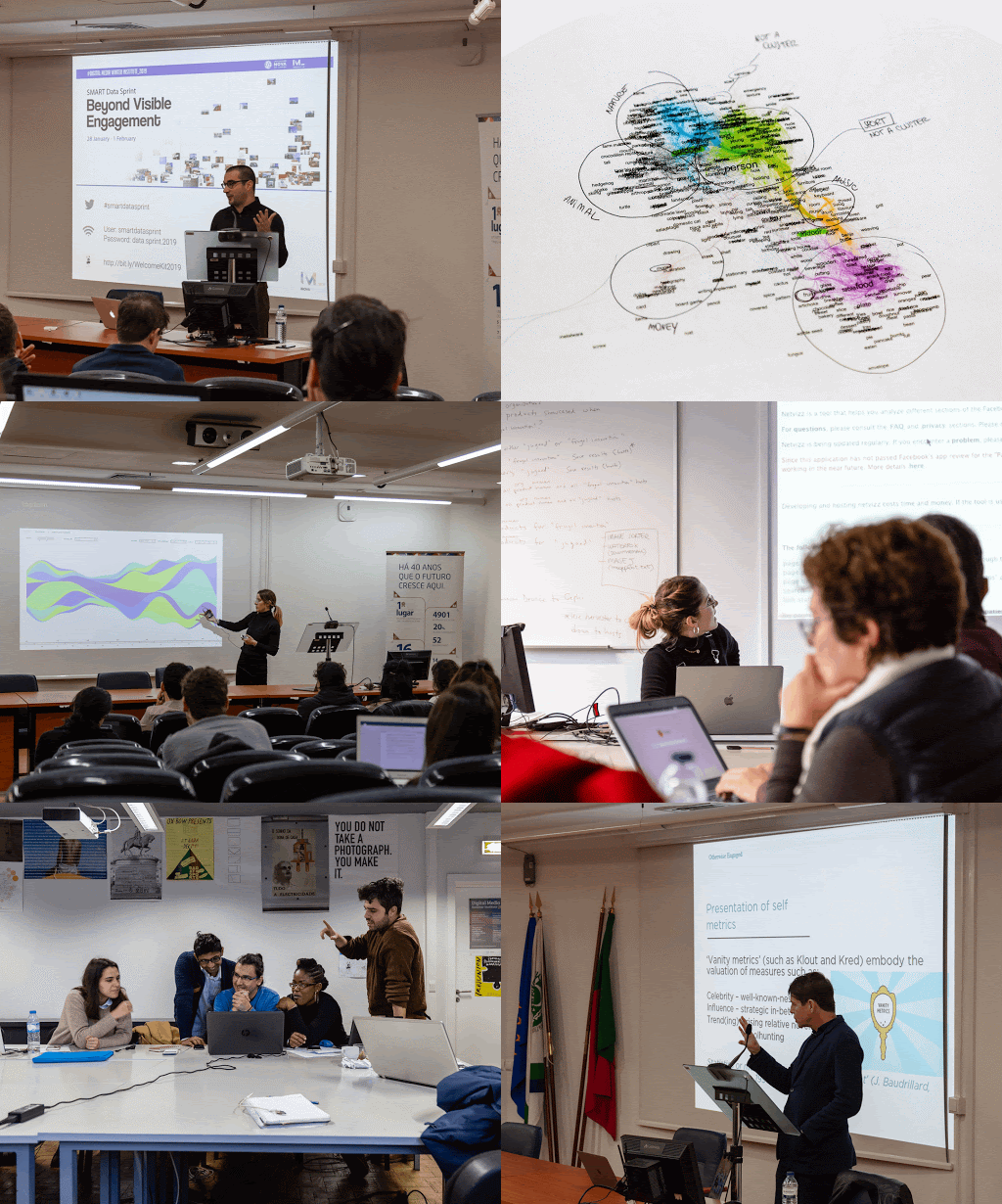
The third edition: Beyond visible engagement, 2019
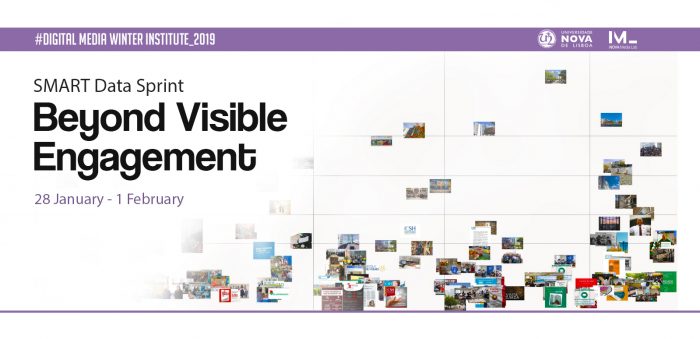
Theme: https://smart.inovamedialab.org/past-editions/smart-2019/
Invited speakers:
Richard Rogers with a keynote talk about critical analytics
Bernhard Rieder with a masterclass on “From Algorithms to Diagrams: How to Study Platforms?”
Short Talks:
André Mintz, Images as networks (and vice versa)
Beatrice Gobbo, Visual Models for Text Visualization. How I failed several times
Janna Joceli Omena, how to read cross-platforms digital networks?
Video list: https://www.youtube.com/watch?v=DpiU4IoQgyI&list=PLcGiWiKtsR0-NixqFGMQ_PE5lmurVBCIH
Schedule: https://smart.inovamedialab.org/past-editions/smart-2019/schedule/
Photo gallery: https://smart.inovamedialab.org/past-editions/smart-2019/photo-gallery/
Projects:
» Exploring the News Apps Environment on Google Play Store, Lead: Dora Santos Silva and Mariana Müller
» Health myths’ circulation on social media: the cases of detox therapies, anti-vaxxers and zika epidemics, Lead: Elaine Teixeira Rabello
» Interrogating Vision APIs, Lead: André Mintz and Tarcizio Silva
» Frugal Innovation, Lead: Miguel Amaral and Elsa Caetano
Invited designers: Beatrice Gobbo and Giacomo Flaim.
Organizers: Janna Joceli Omena, Elsa Caetano, Ana Marta Flores and Cristian Ruiz.
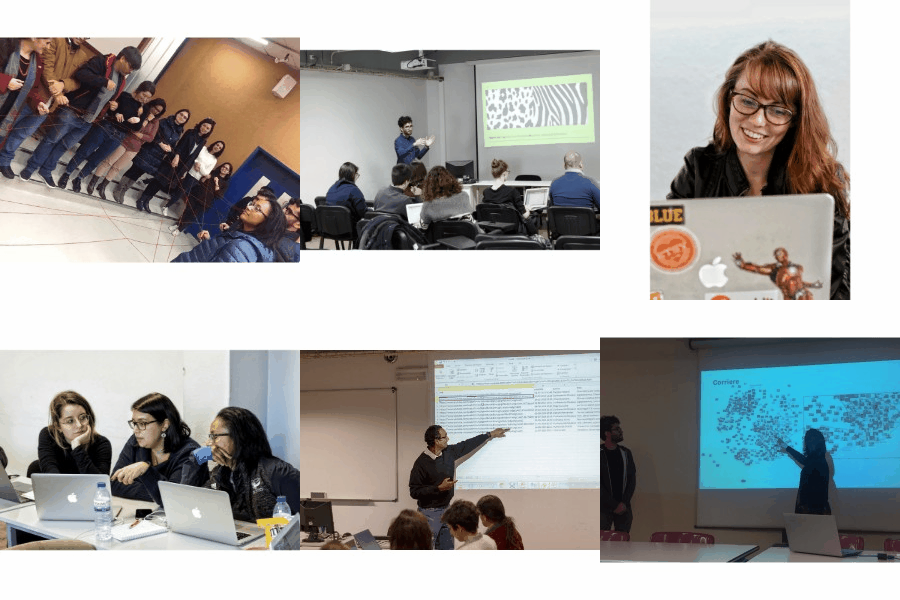
The second edition: Beyond visible engagement, 2018
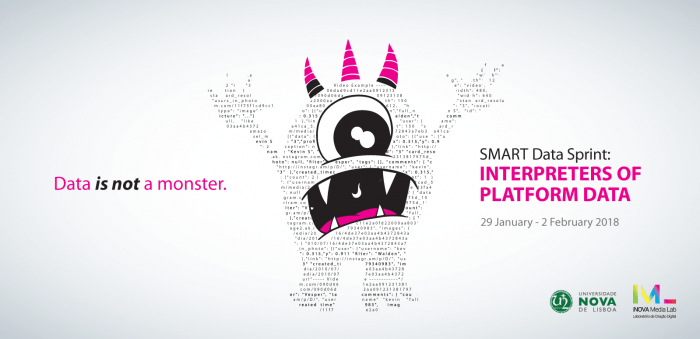
Theme: https://smart.inovamedialab.org/past-editions/smart-2018/
Invited speakers:
Bernhard Rieder, Digital Methods and Computational Analysis: When Does the Black Box Become too Dark?
Dhiraj Murthy, Researching visual social media platforms
Short talks:
Francisco Conrado Filho, Detecting online communities: the case of the Portuguese far-right on Facebook
Janna Joceli Omena, The Grammars of Social Media: thinking platform data under the modes of technicity
Video list: https://www.youtube.com/watch?v=bveMpEtAvug&list=PLcGiWiKtsR0_BTLB4t_WH0iod-hXtX0eU
Schedule: https://smart.inovamedialab.org/past-editions/smart-2018/schedule/
Photo gallery: https://smart.inovamedialab.org/past-editions/smart-2018/photo-gallery-2018/
Projects:
Visualising engagement on Zika epidemic, Lead: Elaine Teixeira Rabello and Gustavo Matta
Femminicidio in Italian media and public debate, Lead: Alessandra Cicali
Mapping Femicide discourses on Twitter, Lead: Inês Amaral
Invited designers: Beatrice Gobbo and Giacomo Flaim.
Organizers: Janna Joceli Omena, Elsa Caetano, Ana Figueiras, Cristian Ruiz and Ana Marta Flores.
Monster design by Rodrigo Silva and Janna Joceli Omena.
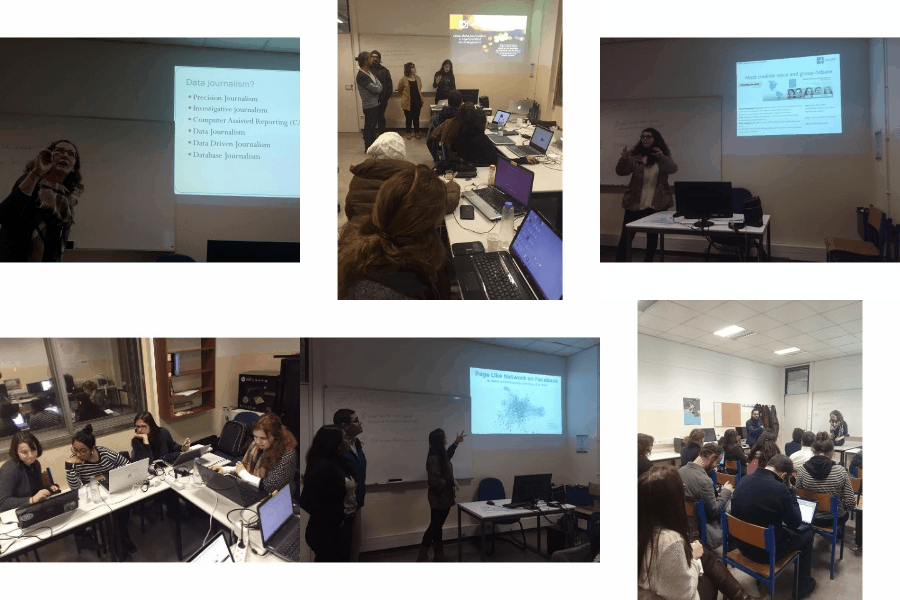
The first edition: What is the data journalism debate on social media?, 2017
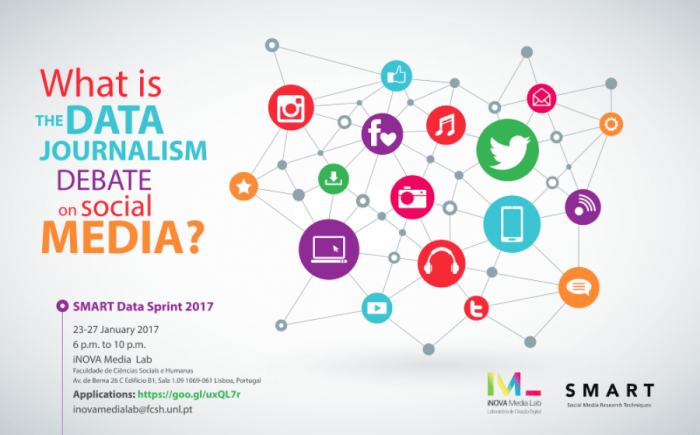
Theme: https://smart.inovamedialab.org/past-editions/2017-datajournalism/theme/
Invited speaker:
Ana Pinto Martinho, ISCTE-IUL, Data Journalism.
Short Talk (by myself) about approaches of Data Analysis
Schedule: https://smart.inovamedialab.org/past-editions/2017-datajournalism/schedule/
Projects: https://smart.inovamedialab.org/past-editions/2017-datajournalism/project-reports/
Photo gallery: https://smart.inovamedialab.org/past-editions/2017-datajournalism/photo-gallery-2017/
Organizers:
Janna Joceli Omena, Elsa Caetano, Vanessa Amaral, Rodrigo Silva and Kalina Drenska.
Everything starts with…(back to 2016)
Many things and people contributed to the beginning of the SMART Data Sprint. Here, I want to describe where this idea came from and how my personal background as a broke PhD student, with one fixed idea in mind, demonstrates that it is possible to make things happen even when the reality is not in our favour. I mean, rather than complaining about the lack of resources, or organisation of the PhD programme, why not make lemonade out of a lemon?
The idea of the SMART Data Sprint came from my experience at the Digital Methods Winter School (in 2014) and Summer School (in 2015) but also from my lack of money to travel to Amsterdam, in 2016, and the creation of iNOVA Media Lab in the same year. Back then, I had applied to four different PhD scholarships (two in Brazil and two in Portugal) without success. There was not enough to pay the PhD programme fee (so I was in debt). Another important aspect is that since my Master’s course (2013-2015) I was looking for a place for exchanging ideas, a research group or people with similar research interests. There were several groups! But only on paper, or better saying on the faculty’s webpage. It is true that lack of resources can lead to dissatisfaction and complaints, but it can also trigger innovation and action. So, the possibility of doing whatever I wanted to at the new digital media laboratory of NOVA FCSH (iNOVA Media Lab), sounds like heaven. If a chance was given to me, I would take it and make the best of it. That was the spirit!
In 2016, the doctoral program, which I was enrolled in, did not offer any perspective close to the digital methods approach, neither other doctoral or master courses in my faculty and university (and if there was one, it would be related to conceptual discussions about big data). To be honest, back then when sharing my ideas of organising a data sprint, many of the people I spoke to, told me it would be too complicated, or too bureaucratic, or that there would be no participants (because it was Wintertime, because the proposal was too specific or because people would not understand it, etc. etc.). I wasn’t doing anything new but following the ideas of an existing model, as they say, copying is the best applause. Looking back, I see that this whole movement was like planting a seed or opening up room to learn, use and develop digital methods for social and media research. Of course, at that time, I had no idea about it, I just wanted to understand how to properly use digital methods in a collaborative environment, while introducing the data sprint potentialities for those willing to engage with this research practice in Lisbon.
Another perspective that helps understand the context in which the data sprint was created is to compare the year 2021 with 2016. Well, in 2021, to mention the idea of using digital methods for social sciences or humanities is definitely a welcome topic and must need discussion that raises the attention and interest of many scholars. Universities all over the place are creating new departments and courses to address the digital, online data, platforms, algorithmic techniques, etc. etc. There are lots of job opportunities to be filled in what concerns research methods and data analysis. There is also an annoying academic trend that reflects the idea of creating, creating and creating “new” digital methodologies or “new” theoretical concepts. However, in 2016, the proposal of learning from and following the medium, while repurposing its methods for research (see Rogers, 2013) was not an easygoing topic. Scholars were quite sceptical about it. Well, they still are but, at least now, they are more open and willing to learn new methods while getting familiar with technological terms and materialities (in concept and in practice).
That is to briefly contextualise the background in which the SMART Data Sprint was created. I also think this background is quite helpful to describe how everything started; and how the newborn iNOVA Media Lab and INCREDIBLE people like Elsa Caetano, Ariane Parente Paiva and Vanessa Amaral (who had never participated in a data sprint before) bought into the idea, dedicating themselves to this project when nobody else did. I remember a meeting with Elsa Caetano, to organise the second edition of the data sprint, it was a weekday, we met late in the evening at the Starbucks of the El Corte Inglês. We were asked to present a budget, and Paulo Nuno Vicente said to me: “make the dream budget”. So, Elsa and I did it and the budget was approved! Did we spend the whole budget on the second edition? Nop, we decided to split it for two consecutive years and ensure the realisation of the second and third edition 🤓👊🏻👩🏻💻 A wise decision that seems to have worked.
In the following years, people such as Ana Marta Flores and Cristian Ruiz were crucial to the organization of the early editions of the SMART Data Sprint, especially for creating communication and dissemination strategies. It is also worth mentioning again Bernhard Rieder who have accepted the invitation to prepare keynotes, tutorials or other forms of collaboration since edition number two, in 2018. Elaine Teixeira Rabello is another name I wanted to highlight here, someone who has believed and supported this initiative. She pitched super interesting projects for three consecutive years (from 2018 to 2020). Beatrice Gobbo and Giacomo Flaim also enter this list of the early editions, as designers, their collaboration with tutorials and the projects were priceless. Why I am focusing on the early editions? Well, because it’s really hard to get support when you don’t have a “name”, and these people (among others), were there in the first steps of the SMART Data Sprint. Not mentioning scholars like Richard Rogers and Tommaso Venturini, who, to my surprise said yes, to be part of the third and fourth editions. They have no idea about how happy I was and my reaction (like Rachel below) when reading the email with the confirmation of their interest in participating of the SMART Data Sprint. Richard’s response was actually in person, we were talking during the coffee break of an event about Instagram studies in the Middlesex University, London. Apparently, he said yes right away but I haven´t got his email! So it felt so good to hear that news in person.
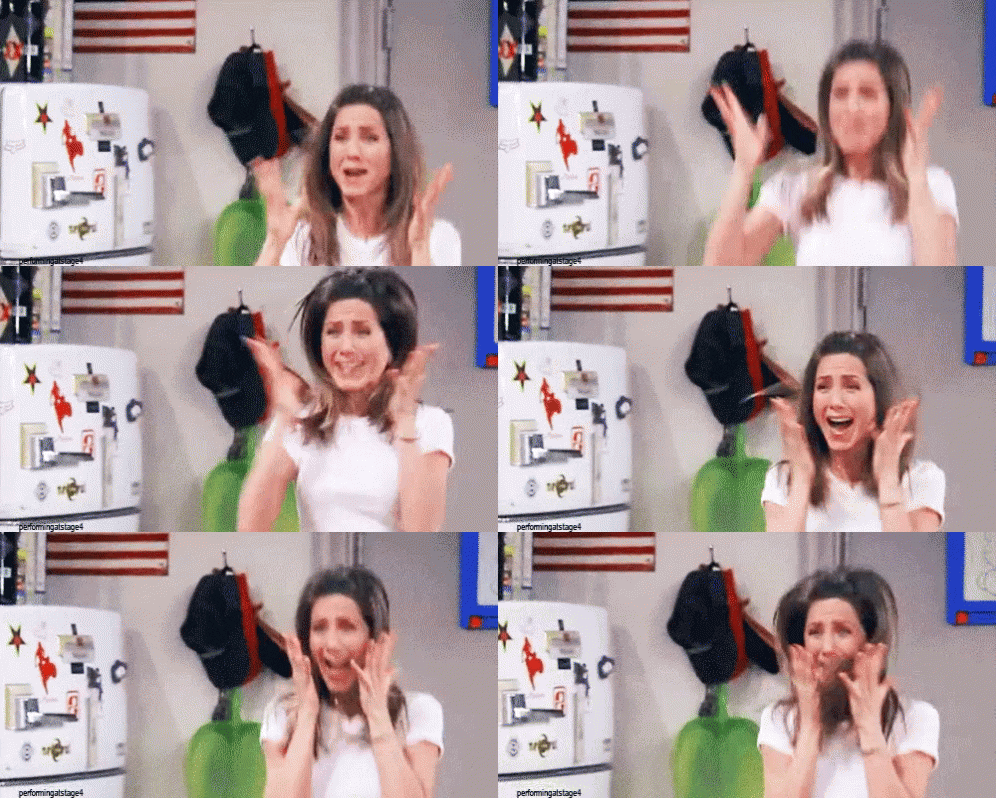
I could literally write many other examples of receiving good news from email, after inviting collaborators and keynote speakers (and my reactions would be as Rachel up here), but I won´t do that, otherwise this post will be endless!
These paragraphs were not written in a way to impress you (if you’re still reading this long post) or to show off me or my work, but to record how this idea was born and to contextualise it a little. That is, of course, something that was part of my last five years. The history of the SMART Data Sprint has also involved so many other collaborators who were not mentioned here, but have contributed to making this initiative real and indeed a unique annual encounter**. So, I hope you have enjoyed the reading, and get to know the backstage of it.
++++++++++++++++++++++++++++++++++++++++++++++++++++++++++++++++++++++++++++++++++++++++++++++++++++++
**This is now an initiative that can keep growing, or simply not evolve anymore due to little institutional support and lack of time of the organisers. I´ve been questioning myself what is the point of continuing to persist and struggle when there is no institutional support. Over the years, persistence and beliefs simply make little sense with so many obstacles ahead, and when there is still little interest or support.

 Janna Joceli Omena
Leave a comment