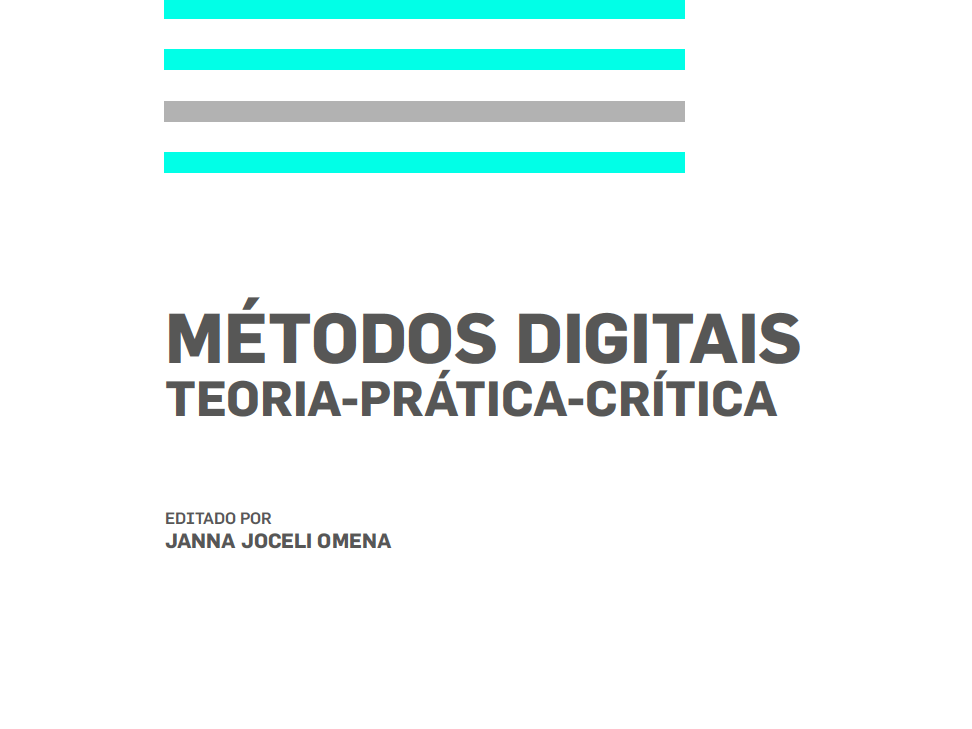
I´m delighted to announce the launch of the book Métodos Digitais: Teoria-Prática-Crítica, part of ICNOVA books and also edited by myself; a very long process of work that started almost two years ago at iNOVA Media Lab, Universidade Nova de Lisboa, in one of the regular meetings of the team of coordinators of the lab. The coordinators were challenged to publish or edit a book in Portuguese. At the time, I thought that the reasonable option was the possibility of editing a book about digital methods. So, the book purpose should contemplate both teaching goals and actually the offering of a referencial literature to students and scholars interested in grasping research based on digital methods perspective, and in Portuguese.
The choice of the chapters to be translated was a decisive element in the composition of the book and also difficult. What articles should be included? Why? After finding a way to respond to these questions, the second challenge was much more difficult: my degree of uncertainty about whether the authors feedback on having their work translated to Portuguese would be positive. Fortunately, all the permissions were given! MANY THANKS to all authors, in particular Richard Rogers (the author of Digital Methods, 2013 & Doing Digital Methods, 2019) Bernhard Rieder (the author of the of forthcoming Engines of Order), Anne Helmond and Tommaso Venturini.
The next challenge was the actual translation process and all possible rounds of revision it required (LOOONG process with great responsibility!). Many thanks to the work, time and dedication of Tiago Salgado for translate core chapters of the book. Tiago was certainly very patient in listening to all my very specific requirements and sometimes agreeing to abide the terms or expressions explicitly defined by my-stubborn-self. All in order to find the words, language and expressions that would remain faithful to the original texts. Great discussions we had along the translation process, thank you Tiago! More special thanks to the incredible work of Filipa Felipe who translated a working paper of Inês Amaral and myself which was filled with technical expressions and very specific terms from the field of digital networks studies. However, the work of Filipa made our english version to turn into an even better version in Portuguese, incredible work! Thank you also for the translations made by Rosanna Carretta and Alda Rocha, which concern the innovative contribution of the role of designers in data sprints from Italian to Portuguese; a chapter written in three hands (Michele Mauri, Beatrice Gobbo & Gabriele Colombo) that had a final and very precise touch, and contribution from the work of Alda Rocha. Many thanks!
Last but not least, another great challenge was to reunite scholars with different backgrounds but connected also to the field of digital methods (from newcomers to experts); a long list of very talented researchers who have collaborated with original chapters to this book. For that, special thanks to Elaine Teixeira Rabello, Inês Amaral, Ana Marta Flores, André Mintz and Beatrice Gobbo. Thank you for accepting the challenge and for bringing with you amazing scholars and designers who added value to this book. You´re the best!
Each translated article and each original chapter was particularly thought to compose a theoretical-practical-critical perspective on digital methods in Portuguese. That is the proposition of Métodos Digitais: Teoria-Prática-Crítica, which is organised in five interconnected parts:
ONE Foundations TWO Concepts, approaches and practices THREE Digital networks and visual affordances FOUR The natively digital thought FIVE Explore in practice, Navigate critically
The book offers referencial chapters written by amazing scholars from different fields and expertises, such as Software Studies, Platform Studies, Digital Sociology, Visual Network Analysis, Data Journalism, Public Health Studies, Information Visualization, Visual Social Media, among others. The introduction of the book, written by myself, can be somehow helpful for those who are willing to understand the role and perspective of digital methods. To me, it was a very interesting exercise; an attempt to unpack these methods by actually questioning what are digital methods? [1]
You can download Métodos Digitais: Teoria-Prática-Crítica in:
[ICNOVA page] https://www.icnova.fcsh.unl.pt/metodos-digitais-teoria%e2%80%90pratica%e2%80%90critica/
[ResearchGate] https://www.researchgate.net/publication/339435021_Metodos_Digitais_Teoria-Pratica-Critica
[Academia] https://unl-pt.academia.edu/JannaJoceli/Books
Enjoy the reading!
************************************************************
[1] In case you know someone who would maybe be interested in translating this introduction written in Portuguese to English, please don´t hesitate in getting in touch with me 🙂

 Janna Joceli Omena
Leave a comment